
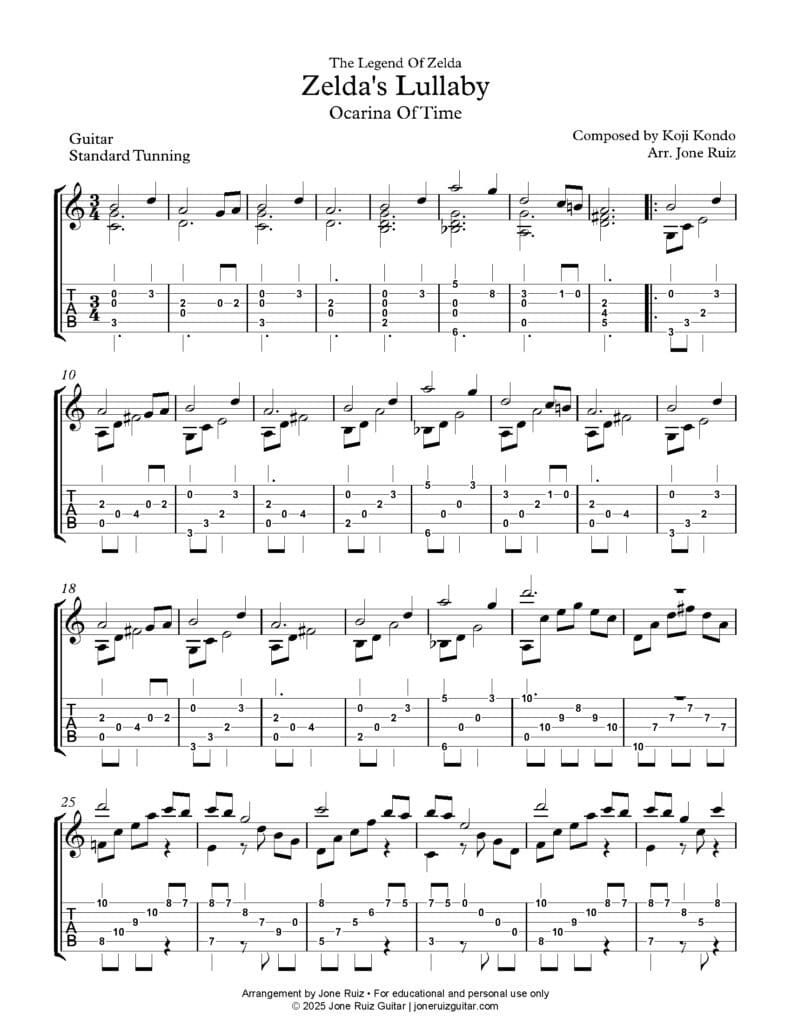
This page includes a first-page preview of my classical-guitar arrangement of “Zelda’s Lullaby,” my complete performance, and a link to the printable PDF tab. I approached the melody as a quiet character theme: the upper voice needs to sound simple and direct, while the arpeggios and bass create the sense of ceremony, memory, and calm associated with Princess Zelda.
The piece is immediately recognizable from only a few notes, which makes balance especially important. A listener should hear the melody first. The accompaniment adds atmosphere, but it should never make the tune feel crowded or overly sentimental.
🎸 View the Complete Zelda’s Lullaby Guitar Tab PDF — $3.99
🎧 Listen to my arrangement on Spotify
Zelda’s Lullaby Guitar Tab at a Glance
| Series | The Legend of Zelda |
| Best-known playable-song appearance | Ocarina of Time |
| Original music credit | Koji Kondo |
| Arrangement | Solo classical guitar by Jone Ruiz |
| Difficulty | Intermediate |
| PDF format | Standard notation and guitar tablature |
Where Zelda’s Lullaby First Appeared
The melody has a history that begins before Ocarina of Time. It appeared in A Link to the Past in music associated with Princess Zelda and her rescue. Soundtrack listings use titles such as “Princess Zelda, Rescued,” while later commentary often calls the melodic idea Zelda’s Theme or Zelda’s Rescue.
Ocarina of Time gave the melody the name most players now recognize: “Zelda’s Lullaby.” Impa teaches it to Link as a sacred song of the Royal Family, and it becomes one of the game’s most useful ocarina melodies.
The rebuilt page explains that evolution rather than presenting “Zelda’s Rescue” as a casual alternate title for every version. The arrangement and product are centered on the familiar Ocarina of Time identity while acknowledging the earlier musical source.
Why Zelda’s Lullaby Works So Well on Classical Guitar
The melody is compact, lyrical, and separated by enough space for the harmony to speak. Classical guitar can place the tune in a warm upper register and support it with arpeggios that feel intimate rather than orchestral.
The repeating accompaniment creates a gentle continuity. It should sound stable, but not mechanical. Small changes in tone, timing, and bass direction can make each return of the melody feel meaningful even when the notes are familiar.
The instrument’s natural decay is also useful. Silence becomes part of the phrase. Allowing one note to fade before the next entrance can communicate more than filling the space with extra harmony.
How I Adapted Zelda’s Lullaby for Solo Guitar
I built the arrangement around three roles: melody, bass, and a soft arpeggiated middle layer. The melody receives the clearest attack and the longest phrase. The bass identifies the harmonic foundation, while the inner notes provide motion without drawing attention away from Zelda’s theme.
Some melodic notes need to continue over a change in the accompaniment. I choose left-hand fingerings that preserve those important tones whenever possible, even when another fingering might feel easier for a single chord.
I also avoid sustaining every available open string. Resonance is part of the sound, but a note that belongs to the previous harmony can weaken the next one. Releasing selectively keeps the arrangement transparent.
The Main Playing Challenge: Calm Without Losing Direction
Slow, gentle pieces can become static when every measure receives the same shape. The player still needs to decide where the phrase begins, where it grows, and where it settles.
I practice the melody alone and identify its destination notes. Then I add the accompaniment at a lower dynamic. If the melody disappears, I do not automatically play it harder; I first reduce the accompaniment and improve the balance.
The pulse should remain dependable underneath expressive timing. A small breath at the end of a phrase is effective, but repeated hesitation before every shift makes the music sound uncertain rather than calm.
How to Practice the Zelda’s Lullaby Guitar Tab
Begin by singing or playing the melody without any accompaniment. Next, practice the arpeggio pattern alone at a soft and even dynamic. Add the bass and listen for the way it changes the harmony before combining all three voices.
Use short phrases and hold the most important melody notes to their full value. A recording from several feet away will tell you whether the theme remains clear more honestly than listening directly over the instrument.
- Learn and sing the melody.
- Practice the arpeggio pattern quietly.
- Add the bass without changing the tempo.
- Combine one phrase at a time.
- Mark which melodic notes must continue through a chord change.
- Shape a complete performance only after the voices are balanced.
Preview the Zelda’s Lullaby Guitar Tab
The image below shows the first page of my arrangement so you can evaluate the notation, tablature, spacing, and general difficulty before purchasing the complete score.
View the complete printable PDF tab
Watch My Zelda’s Lullaby Classical-Guitar Performance
Listen first for the melody and the overall phrase. On a second pass, follow the bass notes and the way the inner arpeggio supports each return of the tune.
What to Listen For
- Melodic simplicity: the theme should sound direct rather than over-shaped.
- Arpeggio balance: the middle layer should remain softer than the melody.
- Bass direction: each bass change should support the larger phrase.
- Resonance: sustained notes should add warmth without blurring the harmony.
- Silence: small spaces help the lullaby breathe.
Zelda’s Lullaby Guitar Tab FAQ
Who composed Zelda’s Lullaby?
Koji Kondo composed the melody associated with Princess Zelda.
Did the melody exist before Ocarina of Time?
Yes. An earlier form appears in A Link to the Past in music connected with Princess Zelda. Ocarina of Time established the “Zelda’s Lullaby” name and playable-song role.
Is this a solo-guitar arrangement?
Yes. I combined the melody, bass, and arpeggiated accompaniment for one classical guitar.
What is included in the PDF?
The complete download includes standard notation and guitar tablature for personal practice and performance.
About the arranger: I am Jone Ruiz, a classical guitarist and music educator with more than 25 years of playing experience. I create, engrave, record, and teach the arrangements presented on this site.
Music and usage note: Zelda’s Lullaby, The Legend of Zelda, and the original composition remain the property of their respective rights holders. This page documents my classical-guitar arrangement, engraving, and performance. A purchased PDF is for personal use; redistribution, reposting, file sharing, and resale are prohibited.
Continue with Song of Healing, compare the Ocarina of Time Title Theme, or browse the complete Zelda Guitar Tabs collection.
For access to my tab library and song requests, join me on Patreon.